
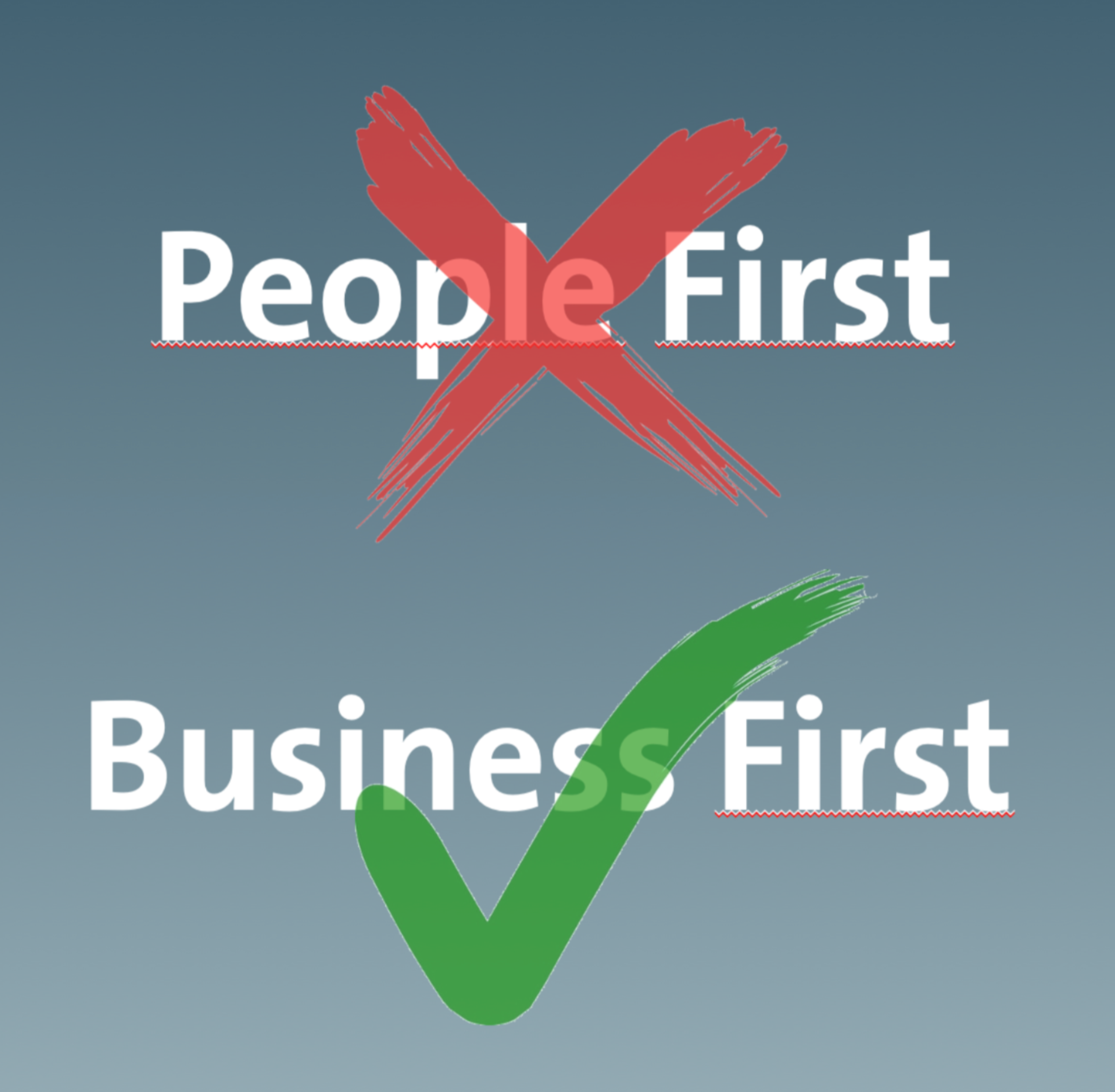
People First? Yes. And no.
"People First" is one of LinkedIn’s most popular quotes. And it sounds obvious. But what does it actually mean in practice? And why is the slogan so often misinterpreted, even though the business has to come first — but through people.
Date
19 January, 2026
Categories
Perspectives
Written by
Linus Holmgren
A treacherous oversimplification
I’ve received a number of reactions to, and had interesting conversations about, my previous LinkedIn post about how the popular “People First” quote is actually often misinterpreted. So I’ll develop the thoughts a bit here.
“People First” is one of LinkedIn’s most used quotes and is often attributed to Richard Branson. (Isn’t it fascinating that there are still people who wake up in the morning and feel a strong need to post a quote by S. Jobs, R. Branson, D. Lama or W. the Pooh?)
The problem isn’t the words themselves, but the interpretation. Many read People First as meaning that employees should come first in every decision. That the business should adapt to people. That wellbeing outranks results. I’d argue that’s a treacherous oversimplification that makes you focus on the wrong things, and start at the wrong end.
The mission comes first
An organisation doesn’t exist to be attractive. It exists to carry out a mission. To create value. To deliver something that someone else is willing to pay for, or that society needs.
So something has to come first. And that is the mission. The purpose. Why you exist.
But — and this is crucial — the mission is realised through people. That’s where the real Talent Mindset moment arises.
Business first. Through people.
That means employees are not an end in themselves. But they are an important lever. It means culture is not the goal. But structure and the right conditions are the foundation that makes culture possible. It means wellbeing is not the strategy. But the right conditions to be able to, want to, and be allowed to perform — that is the strategy.
This is where the watershed lies.
Structures shape culture
In many organisations, leadership knows that people are crucial. The problem is rarely a lack of insight. The problem is how you put it into practice. HR often gets stuck in “ice cream and balloons”, engagement initiatives, value words and campaigns, when the real work lies in structure, mandate, governance and processes.
Structure sets the boundaries, and is the pool edge. Culture is the water that fills it.
If you want to change the culture, you start with the architecture: how decisions are made, how responsibility is distributed, how performance is followed up, and how mandate is granted. That’s where Talent Mindset becomes concrete.
A Talent Mindset means holding two thoughts in your head at the same time: the right people make an enormous difference, but the right people without the right conditions do not.
It’s not about chasing A-players at any cost. It’s about matching. The right competence for the right role. Experience weighs as heavily as potential. The purpose of recruitment is not to maximise perceived fairness, but to secure the best possible match for the mission.
Power hasn’t necessarily shifted. But the playing field has changed. Transparency is greater. Mobility is higher. In some roles there is a shortage, in others a surplus. That requires more than slogans.
So: People First does not mean that people are the goal. It means that people are the key. And that is a crucial difference.
Relaterade inlägg
People First? Yes. And no.
"People First" is one of LinkedIn’s most popular quotes. And it sounds obvious. But what does it actually mean in practice? And why is the slogan so often misinterpreted, even though the business has to come first — but through people.

Ska HR vara vänner med medarbetarna?
En diskussion blossade nyligen upp på LinkedIn mot bakgrund av artikeln ””inte dina vänner” – Ilskan växer mot HR” i SvD. I ljuset av detta så blir frågan aktuell - är det meningen att HR ska agera som vänner gentemot de anställda?

Några obekväma sanningar om HR
När HR debatteras i media så stannar ofta debatten på en rätt trivial nivå – det är rätt/fel och bra/dåligt. Känslor och upplevelser dominerar berättelsen. Det är lätt hänt att faktiska utmaningar hamnar i skymundan i dessa debatter och att verkliga problem blir kvar under mattan. Jag vill belysa några av dem i denna artikel.
𝗠𝗼𝗱𝗶𝗴 𝗛𝗥 – 𝗻𝗲𝗷 𝘁𝗮𝗰𝗸
(Och varför flygledarledarskap borde vara HR:s mantra)
Employer branding has grown up. Now it must find its role!
We were asked to write an article in Magnetude, Magnet Awards' magazine, about the future of employer branding as a discipline in its own right, but above all its connection to the bigger picture.
Stop pointing at HR, or The buck stops here
HR can support, provide structure and create tools. But HR does not lead the teams, does not set day-to-day priorities and does not set the tone for psychological safety. You do, as a manager.
It’s time to modernise HR work – properly
HR has evolved over a hundred years, but are the structures built for today’s demands? If employees are crucial, why is there then a lack of overview, insight and control over structures and the ability to deliver?
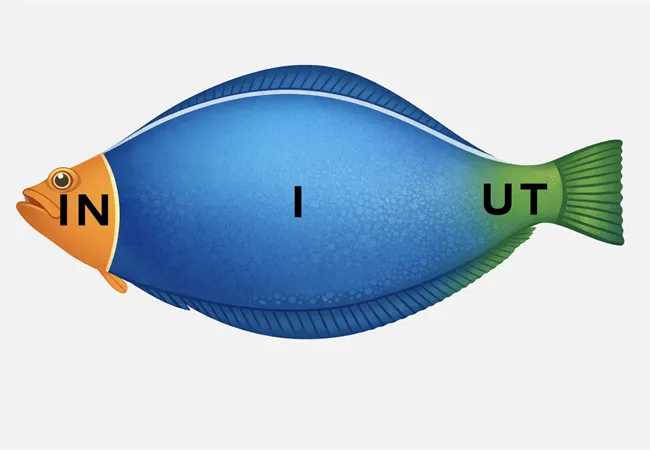
ARUBA, the Underground map and why we also need the HR flounder
The ARUBA model has helped HR create structure and understanding. But it is not particularly good at clarifying where value is actually created.